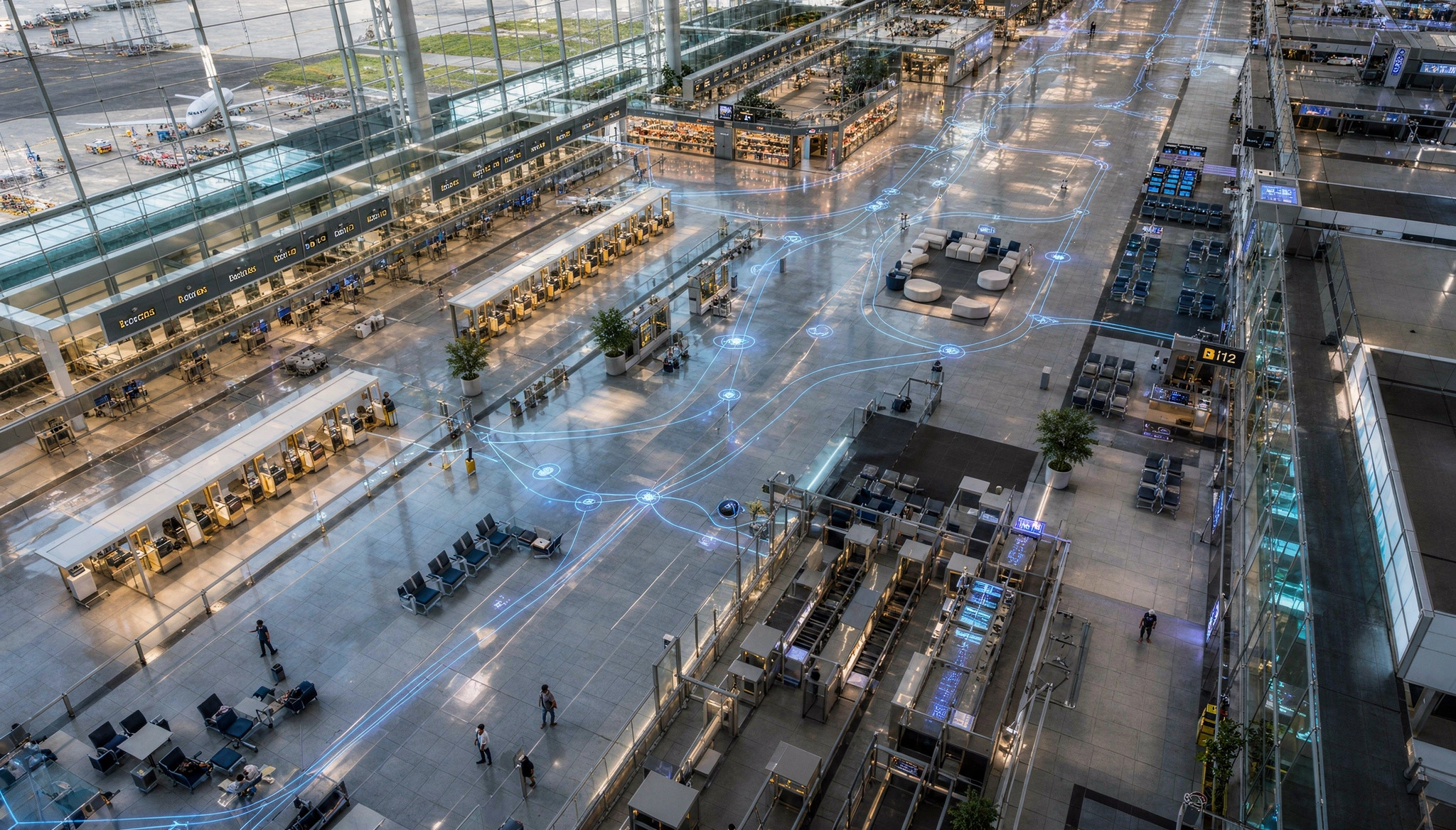
A digital twin is not a visualisation tool. It’s a live operational mirror of the airport that continuously updates real-time data from sensors, flight feeds, and ground systems, that shows what’s about to happen before it actually does.
Consider what a flight delay looks like from a passenger’s perspective. The departure board initially shows the flight as on time, then changes once, and later changes again. By the time boarding begins, a connecting flight has been missed, and the passenger has spent more than an hour waiting for updates that arrived too late to be useful.
The delays that create this experience are rarely caused by a single failure. More often, they result from a chain of decisions made without a complete operational picture. A gate may be assigned without visibility of an incoming delay, a ground handling team may be deployed without access to real-time turnaround data, or a security checkpoint may remain staffed at normal levels despite an impending surge of delayed arrivals.
These are exactly the challenges that a digital twin addresses. Rather than adding another layer of technology to an already complex operational environment, a digital twin creates a unified, continuously updated view of airport operations. By bringing together data from across every function, it provides a real-time understanding of what’s happening throughout the airport.
What is a digital twin?
The term “digital twin” is often used broadly across the industry, making it important to define it precisely. A digital twin is a virtual representation of a physical airport that is continuously synchronised with real-time operational data. This data can come from a wide range of sources, including sensors on baggage handling systems, boarding bridges, HVAC equipment, and escalators, as well as air traffic control feeds, flight information systems, ground handling platforms, and passenger flow analytics derived from cameras and location-tracking technologies.
McKinsey’s October 2025 analysis identified digital twins as the emerging technology with the greatest potential impact on airport operations. By providing a holistic, connected view of the airport ecosystem, digital twins enable faster, more informed decision-making across functions. Yet, despite their potential, adoption remains limited. The same report found only 8% of airports have fully deployed digital twin capabilities, while many others have yet to begin implementation.
How the passenger feels the difference
Passenger flow is one of the clearest examples of the value digital twins can deliver because it is where passengers experience the impact most directly.
In terminals that lack real-time visibility into passenger movement, operational decisions are often driven by observation rather than live data. A security lane may only be opened once a supervisor notices a queue building. A gate may be assigned based on a scheduled arrival time rather than the aircraft’s actual position. A baggage carousel might be allocated before the flight’s stand has been confirmed. Individually, these decisions seem minor, but they are often made just a little too late.
A digital twin fundamentally changes the timing and quality of those decisions. By combining flow sensors, occupancy data, and live flight information, it can identify a developing security bottleneck 20 minutes before it becomes visible on the terminal floor. A gate reassignment can be communicated instantly across baggage operations, ground handling teams, and retail staffing plans rather than passing through multiple manual handoffs. When a surge of arriving passengers is still minutes away, the system has already modelled its likely impact on connecting flights, gate capacity, and surface transport services.
Passengers rarely notice the technology behind these improvements. What they experience instead is a shorter queue, accurate gate information, and baggage arriving when expected. The digital twin itself remains invisible and that invisibility is a sign that the system is working exactly as intended.
Terminal operations: from reactive to predictive
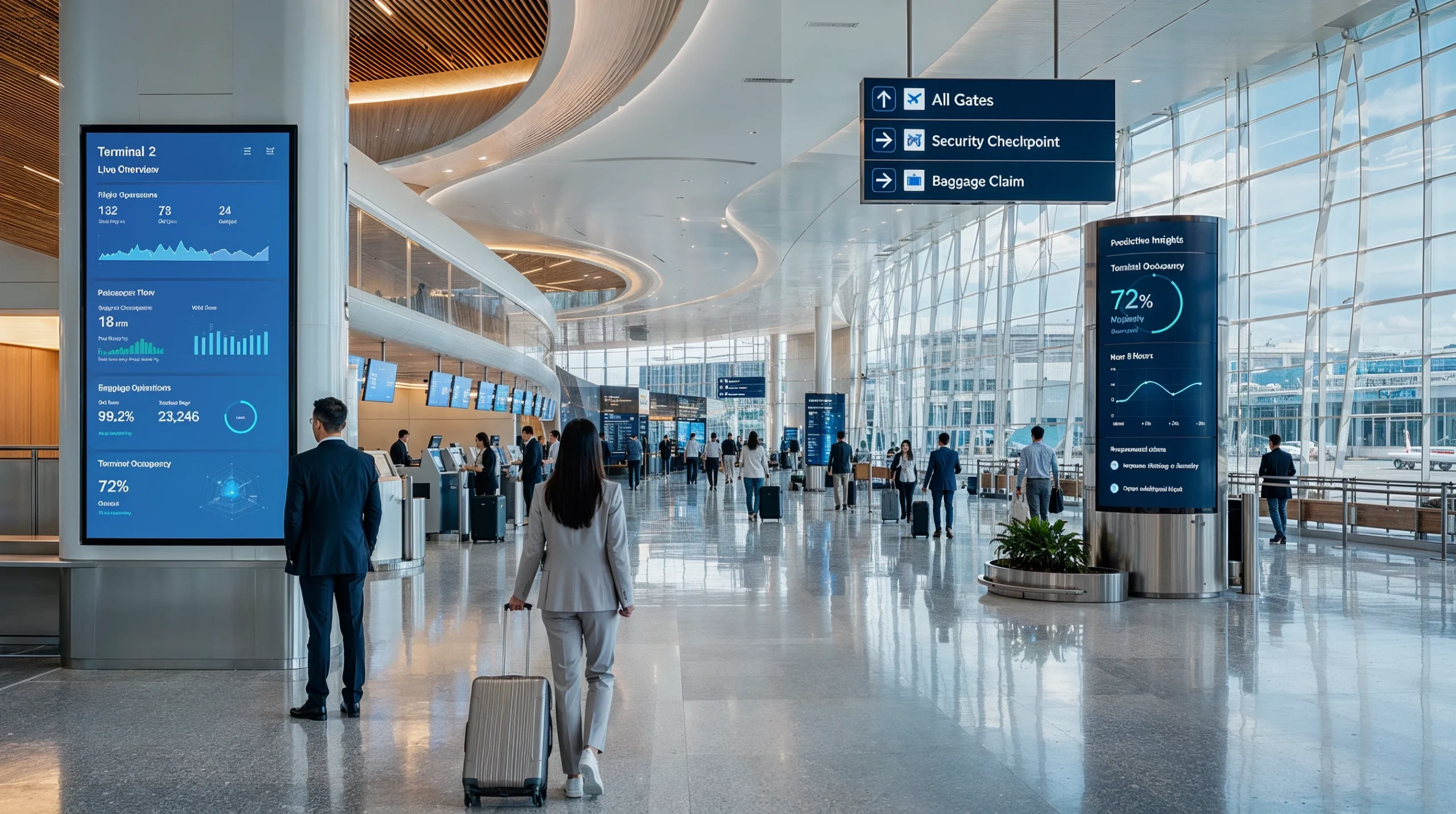
The same principle that improves passenger flow extends across every operational system within the terminal. A digital twin does more than provide a real-time view of current conditions; it continuously models what is likely to happen next, enabling airport teams to anticipate and respond to operational challenges before they escalate.
At Dallas Fort Worth International Airport, a digital twin programme initially deployed in Terminal D and subsequently expanded has enabled real-time tracking of ground support equipment, fuel trucks, catering vehicles, and baggage handling assets. By improving coordination across turnaround activities, the airport has reduced aircraft turn times by between five and twelve minutes per rotation. At a major hub, even a small reduction in turnaround time can create significant value.
Vancouver International Airport uses a digital twin to evaluate the operational impact of infrastructure changes before committing capital investment. Proposed gate expansions, revised check-in layouts, and escalator relocations can be tested against real passenger flow patterns in a simulated environment. This allows planners to identify potential bottlenecks before construction begins, reducing the risk of costly changes that solve one constraint while creating another.
Similarly, Singapore Changi Airport applies digital twin technology to the Skytrain network that connects its terminals. By simulating different scheduling scenarios and monitoring occupancy levels in real time, the airport can optimise passenger movement and reduce wait times across both airside and landside transport networks.
This same operational approach underpins AeroWise, the digital twin platform developed by WAISL. By bringing together data from terminal, airside, and landside operations into a single, unified view, the platform delivers predictive, prescriptive, and simulation-based insights that help airport operators move from reactive decision-making to proactive management.
The gate: where flow, turnaround, and revenue meet
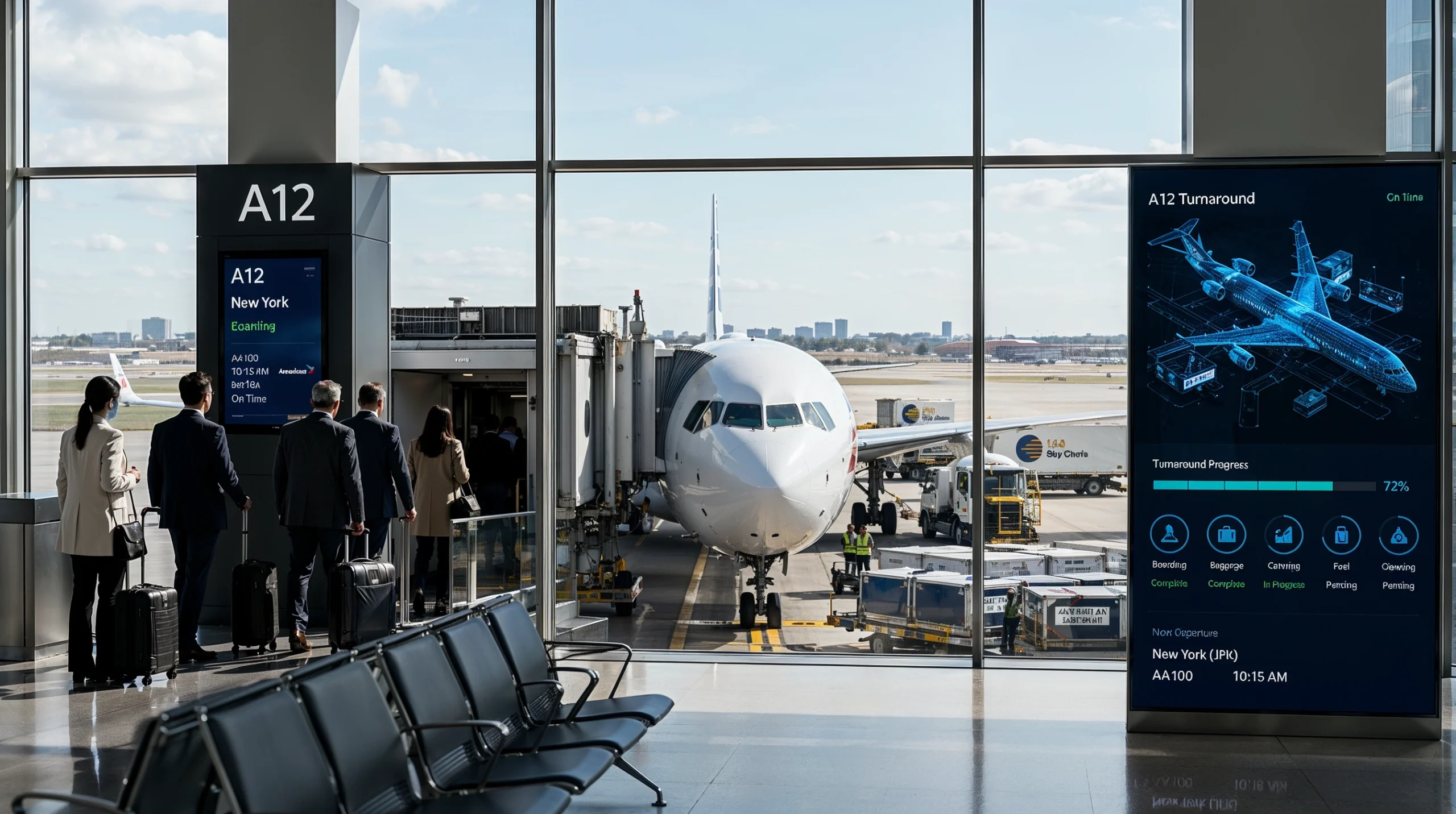
The gate is one of the most critical points in airport operations, where passenger experience, operational efficiency, and commercial performance intersect.
Digital twins provide operations teams with a comprehensive, real-time view of every factor influencing gate readiness. Aircraft position, stand availability, ground support equipment, crew deployment, fuel status, catering progress, and boarding activity can all be monitored within a single operational environment.
The result is a more efficient and predictable turnaround process, with gates becoming available when and where they are needed. For passengers, this translates into more reliable departures and a smoother travel experience. For airport operators, it means greater utilisation of existing infrastructure.
Energy and infrastructure: the benefit passengers never see
Beyond improving passenger flow and aircraft turnaround, digital twins provide another category of value that passengers rarely notice directly but benefit from every day.
By bringing together sensor data from HVAC systems, baggage handling equipment, boarding bridges, escalators, airfield lighting, and other critical assets into a single operational view, a digital twin can detect early signs of equipment degradation before they develop into service-disrupting failures. This enables maintenance teams to proactively schedule repairs during low-traffic periods when there is less impact on passengers.
The same integrated view also supports more intelligent energy management. HVAC systems, terminal lighting, and power distribution can be adjusted dynamically based on actual occupancy and operational demand. The result is lower energy consumption and improved operational efficiency, achieved without compromising passenger experience.
The deployment gap is the opportunity
McKinsey’s finding that only 8% of airports have fully deployed digital twin capabilities is striking given that the same analysis identified digital twins as the technology with the greatest potential impact on airport operations.
The barriers to adoption are largely practical rather than conceptual. Fragmented data environments, constrained budgets, complex stakeholder ecosystems, and uncertainty about how to scale beyond pilot programmes continue to slow implementation.
Success depends on working with an integration partner that understands both the operational realities of a live airport environment and the data infrastructure required to connect systems into a cohesive whole. WAISL’s systems integration approach is designed to support this journey.
Airports that have progressed from experimentation to full-scale implementation are already realising compounding benefits. Faster aircraft turnarounds, smoother passenger flow, improved gate utilisation, lower energy consumption, and reduced infrastructure downtime do not generate value in isolation.
For airports still in the planning or pilot phase, the opportunity remains within reach. However, the competitive advantage created by digital twins will not remain in reach forever. As leading airports continue to raise standards for efficiency, reliability, and passenger experience, travellers will increasingly come to expect the same level of performance wherever they fly.
WAISL helps airports build the connected digital infrastructure that makes digital twins both deployable and effective across every operational function. To learn how a unified digital foundation can improve passenger flow, terminal operations, and overall airport performance, get in touch with our team.