
According to the International Civil Aviation Organization (ICAO), non-aeronautical business, such as retail, F&B, parking, advertising, and commercial leasing, contributes nearly 40% of an airport’s total revenue, making even small operational and billing inaccuracies financially significant.
Revenue leaks usually start with a number that doesn’t quite add up. These numbers are usually missed. For example:
- When a finance head reviewing monthly retail revenue notices that the concessionaire’s reported turnover sits lower than the footfall.
- When an operations manager spots a gate was reassigned twice in an hour, but the original airline was still billed for the stand.
This is what revenue leakage looks like at most airports. It’s essentially a systems integration gap. This is the quiet space between platforms that were never built to talk to each other, where small errors accumulate into a number that eventually demands an explanation.
If that number has started showing up on the desk, here’s where it’s coming from, what it’s costing the business in places that often go unchecked, and what it actually takes to close it for good.
Step 1: Spotting the pattern behind the discrepancy

The first challenge is recognising a one-off discrepancy that’s actually a pattern. It can be anything: a landing fee calculated using last quarter’s aircraft weight data because records weren’t updated. Or it could be a retail tenant’s monthly report showing one figure while the point-of-sale system shows another. In these kinds of situation, reconciliation can consume days rather than minutes.
Individually, each of these reads as an administrative error. Collected over a year at a major hub, these discrepancies stop looking like isolated mistakes and start revealing a structural problem. Data is scattered across billing, occupancy, and operational systems, and each system holds only part of the picture, so everything must be pieced together manually.
But where are the leaks actually hiding?
1. The billing layer
Inaccurate billing is almost always a reconciliation problem that happens when tariff data, occupancy data, and invoicing data sit on separate platforms, errors creep in at the handoff points between them, not because anyone made a deliberate mistake, but because nobody had a single source of truth to check against.
2. The resourcing layer
Resource misallocation costs just as much as inaccurate billing, only it rarely shows up as a line item. It can arise when the check-in counter sits idle during peak hours because the roster was built against a scheduled arrival time rather than the aircraft’s actual position. Multiply that across every terminal, every shift, every season and the inefficiency quietly drains margin every single day without ever appearing on a balance sheet.
3. The visibility layer
Underneath both of these sits the real root cause: a data gap. When passenger processing data, retail data, and operational data live in separate silos, there’s not one accurate view of what’s actually happening on the ground. Tariff structures go unreviewed because they’re not being cross-checked against actual utilisation. Most revenue assurance teams catch a great deal, but they can’t catch what the systems themselves never surface.
Step 2: What closing the gap actually looks like
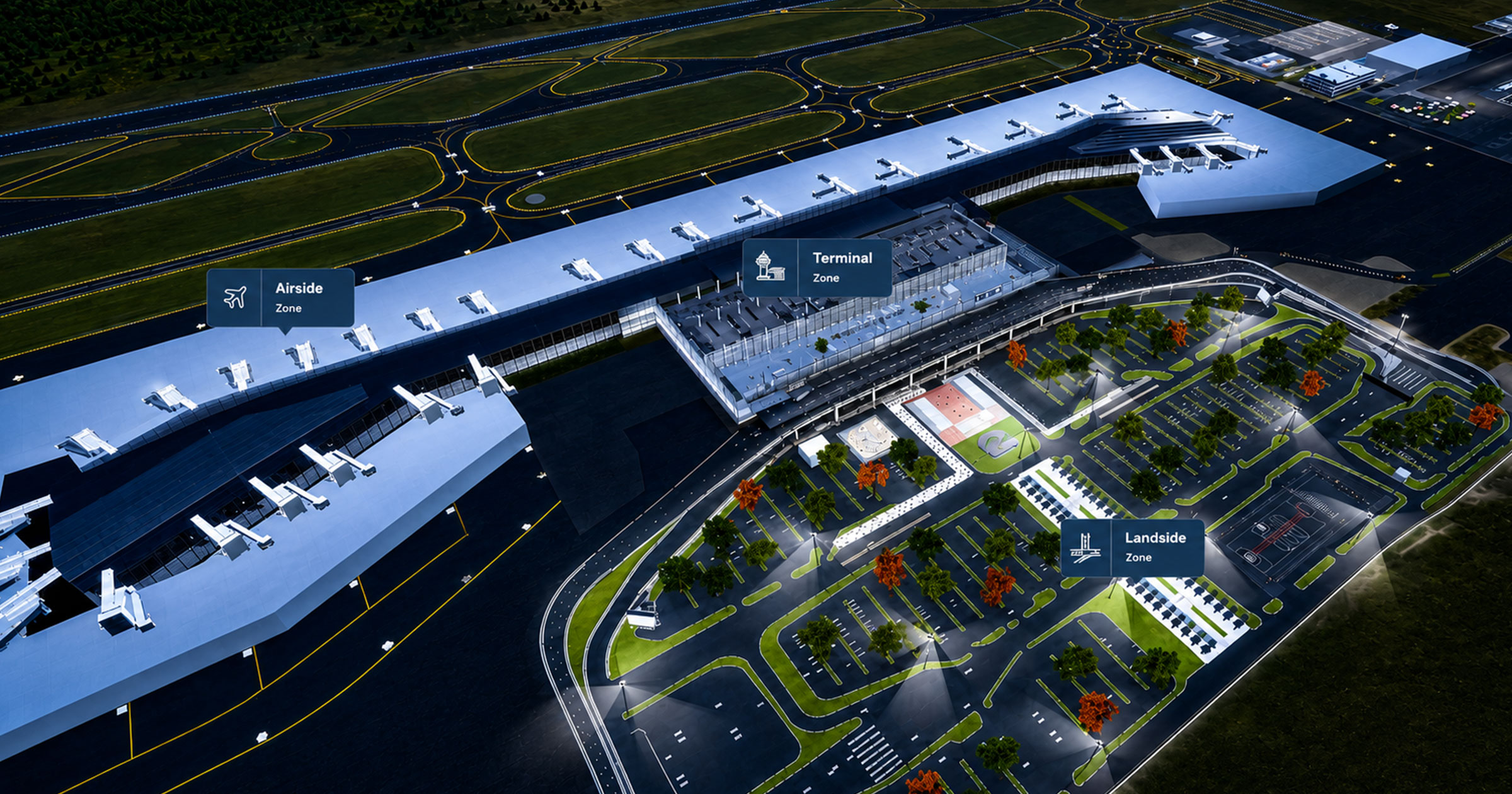
This is the part most finance and operational leaders haven’t seen in practice, because most airports are still operating with the fragmented version described above. Here’s what changes once billing, operations, and resourcing sit on one connected backbone.
Billing accuracy stops depending on manual reconciliation. Once landing fees, parking charges, and retail revenue all draw from the same operational source of truth, discrepancies get flagged within hours instead of being discovered three months later during a quarterly audit.
Resourcing becomes a live decision rather than a fixed schedule. This is the principle behind AeroWise: WAISL’s predictive analysis and operations management platform, which gives airport teams a unified, real-time view of landside, terminal, and airside activity. When staffing, gate assignment, and equipment deployment respond to live occupancy and flight data instead of a roster built a week in advance, the idle counter and the overstaffed carousel stop happening by default.
Forecasting starts working for operators rather than against them. AI and predictive analytics are only as useful as the data feeding them. If they’re fed fragmented inputs, they produce fragmented outputs. If they’re fed one reliable operational picture, they start surfacing revenue patterns long before a leak is large enough to notice on a spreadsheet, whether that’s a tariff slab quietly under-performing or a concession consistently under-reporting turnover.
Commercial revenue gets easier to read in real time. Retail and parking income is easy to optimise when occupancy, dwell time, and transaction data sit on one connected layer rather than three separate layers. WAISL’s retail POS and analytics capability gives operators a live, accurate read on which concessions and pricing structures are performing, instead of waiting on a monthly report that arrives too late to act on.
Step 3: Securing what’s connected
None of this connectivity is worth much if it isn’t secured properly. Financial systems that now talk to each other across an airport’s network need protection as much as they need integration. A cybersecurity solution is built into the integration from day one, ensuring a connected billing infrastructure becomes a source of protection rather than a new point of vulnerability.
Where to start the audit
Addressing revenue leakage doesn’t necessarily require another point solution to be added to an already complex technology stack. It begins with a clear understanding of how billing systems, operational workflows, and data infrastructure interact and where disconnect allows revenue to slip through unnoticed. A structured audit helps to identify these gaps and their impact and to prioritise the areas where improvements deliver value.
Airports that are reducing revenue leakage are not simply deploying more technology. They’re building connected digital ecosystems where operational, financial, and commercial systems work together seamlessly, enabling accurate billing, optimised resource allocation, and real-time visibility across the airport.
As airports continue to modernise, integrated and data-driven operations are important for strengthening revenue assurance and improving operational resilience. Drawing on extensive experience in airport technology integration and digital transformation, WAISL enables airports to connect disparate systems, improve data visibility, and establish the foundation for more efficient and revenue-conscious operations. Get in touch with our team to learn more.