
A single missed pushback slot rarely remains a single problem. It nudges the next arrival into a holding pattern and puts the crew off their schedule. By the third rotation of the morning the apron looks nothing like the plan drawn up the night before. Multiply that across a full day of traffic and the gap between planned and actual capacity begins to explain the operational strain on most airports.
The pressure behind this is structural, not seasonal. IATA’s analysis of European air traffic delays found that ATFM delays rose by 82.7% between 2015 and 2025, while traffic grew by only 11.5% over the same period. That gap is evidence that runway and apron capacity has not kept pace with demand, and adding staff rarely fixes a problem rooted in how airports plan capacity. WAISL’s aviation division has spent years working through this exact gap, and a digital twin is usually where the work begins.
The question worth answering is what that means in practice: not the marketing version of a digital twin, but a working framework an airport can use to plan runway and apron capacity with greater confidence.
Why capacity planning keeps falling short

Most runway and apron plans are still built on average figures. Average turnaround time, average taxi time, average gate occupancy. These averages smooth out the very thing that causes delay: variability. A stand that turns an aircraft around in 35 minutes on a calm day can take 55 minutes on a day with three late arrivals and a ground stop upstream. Both the figures are correct. They simply describe two completely different operating days. A plan built on the average between them fails both.
Static planning tools can’t show a swing before it happens. A masterplan review, refreshed only every few years, tells an airport what its infrastructure could theoretically handle under textbook conditions. It says almost nothing about what happens when three wide-bodies land within 11 minutes of each other and the remote stands are already full. Planners end up managing the airfield through instinct and radio calls, not because they lack skill, but because the tools available to them were never designed to model what’s happening in the here and now.
What a digital twin actually models
In this context, a digital twin is a live virtual replica of the airport, fed continuously by flight schedules, surveillance data, stand and gate status, and ground handling activity. It’s not a simulation run once a quarter for a masterplan review. It updates in near real time, so planners can see how a single inbound delay ripples through stand assignments, taxi routes, and departure sequencing before it becomes a queue on the apron.
The distinction matters. A conventional simulation answers: what would happen if? A digital twin answers: what is about to happen? It draws on the same live data the tower and the apron control team are already looking at modelled forward. WAISL’s AeroWise platform was built around this principle, pairing digital twin modelling with predictive analytics so that airside teams get a forecast rather than a report card. At Rajiv Gandhi International Airport, this approach now tracks more than 100 KPIs across the airport ecosystem in real time, giving a sense of how granular this kind of modelling can become once the underlying data is in order.
Two capacity problems, one framework
Runway capacity and apron capacity are usually treated as separate planning exercises, run by separate teams, using separate tools. That separation is part of the problem. A runway configuration change, moving from mixed-mode to segregated operations during a weather event, for instance, carries immediately into which stands can realistically be used next, how long taxi times will run, and where congestion builds on the apron. A framework that models these in isolation will always be a step behind.
A practical framework treats the runway and the apron as one connected system; that’s what they are. The twin needs to see arrival and departure sequencing on one side, and stand, gate, and turnaround status on the other. They’re updated together rather than on separate refresh cycles which can drift out of sync over the course of a busy day.
Building the framework: what holds up in practice
Model the constraint, not the whole airport. Every airfield has one or two genuine bottlenecks: a single runway configuration, a cluster of remote stands, or a taxiway that backs up during pushback banks. A twin that tries to model everything at once becomes slow, expensive to maintain, and hard to trust. Start narrow, prove the value against a bottleneck the operations team knows about, then widen the scope once the model has earned some credibility on the ground.
Feed it operational data, not scheduled data. Scheduled turnaround times are aspirational, written into the timetable months in advance. Actual chocks-on to chocks-off times, real taxi durations, and genuine stand-occupancy patterns make a twin’s forecasts believable to the controllers who have to act on them. A model that quietly reverts to the published schedule whenever live data is missing will lose the trust of its users.
Connect apron planning to the wider operational picture. A twin that only looks at aircraft movements misses half the story. Baggage flow, crew readiness, and passenger connection risk all affect how quickly a stand clears. This is where AI and predictive analytics earn their place, turning apron data into an early warning rather than a historical log that only tells planners what has already gone wrong.
Give the model a decision loop, not just a screen. A forecast that sits unread on a dashboard changes nothing. The framework needs a defined action for each type of alert: reassign a stand, adjust a taxi route, flag a controller. Airports that treat the twin as a passive visualisation tend to see engagement drop off within months. Airports that build alerts into existing shift workflows see the opposite results.
The data foundation nobody wants to talk about
None of this works if the data is scattered across multiple systems that don’t talk to each other. A twin fed by inconsistent stand codes or mismatched flight identifiers produces confident, but inaccurate predictions. This is worse than no prediction at all, because staff act on it believing it to be accurate. Getting the foundation right usually means addressing master data management before modelling starts, and treating systems integration as core infrastructure work.
This is the least glamorous part of the whole exercise, and it’s also the part most airports underfund. A beautifully rendered 3D airfield sitting on top of unreliable data will lack credibility. It will simply look more convincing while being wrong.
The human side of the framework
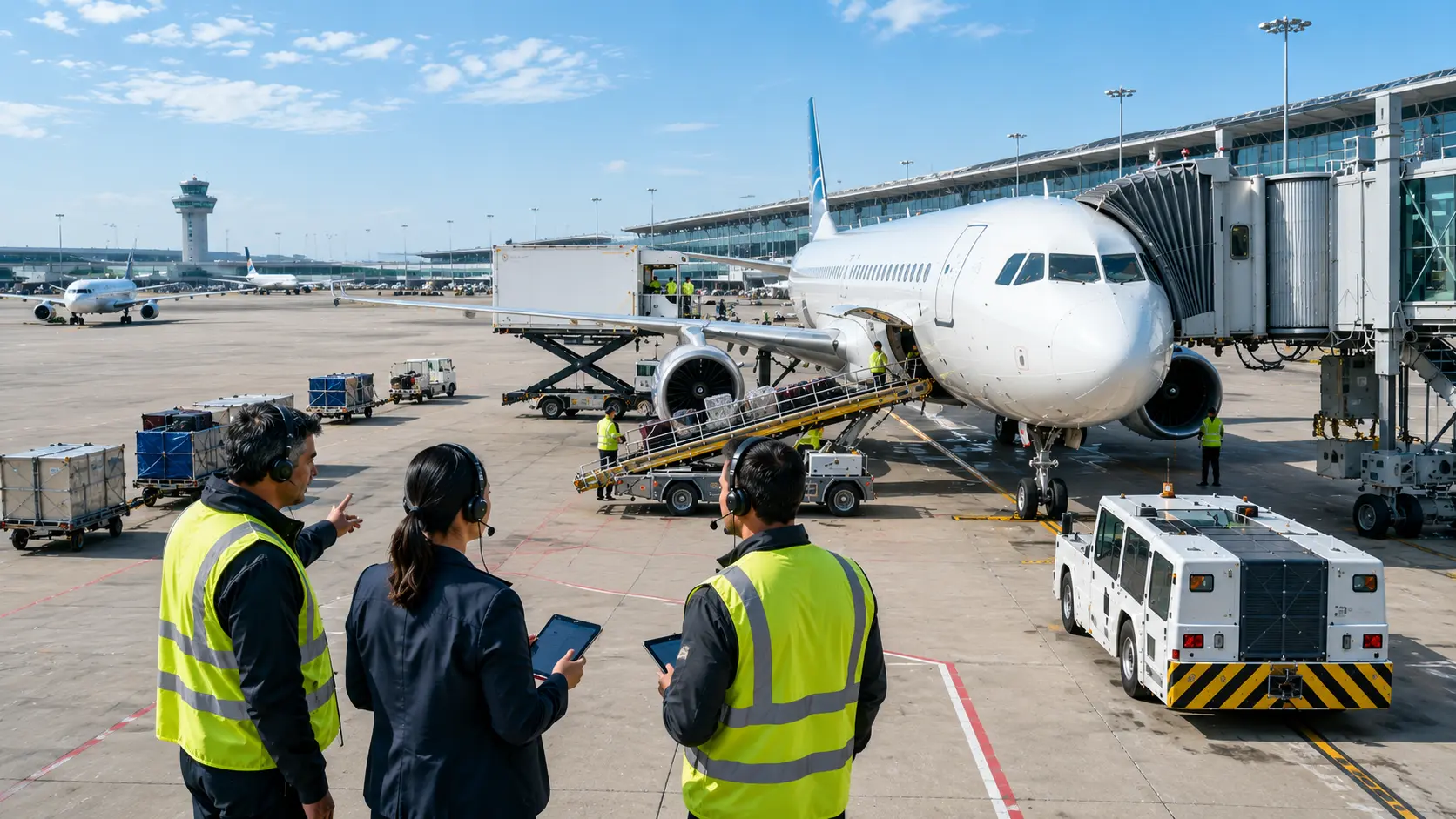
None of this replaces the people running the airfield. A prediction is only useful if someone has the authority and the operational context to act on it. That still requires trained controllers and ramp supervisors who understand both the technology and the reality on the ground. Airports getting the most value from digital twin frameworks tend to be the ones treating the model as decision support for their teams, not a replacement for judgement built over years of shift work.
Where airports get this wrong
The most common mistake is buying the visualisation before fixing the data, chasing an impressive-looking model without doing the mundane work underneath it. The second is treating the twin as a planning exercise conducted once a year rather than an operational tool checked every shift. Capacity planning built on a digital twin only pays off when controllers, ramp supervisors, and planners are all working from the same live model, not separate versions of the truth sitting in separate systems.
What this means for airport leadership
Runway and apron capacity will keep tightening as traffic grows faster than new infrastructure can be built. A digital twin will not add a runway or conjure up a new stand. It changes how well an airport uses the capacity it already has, and that difference shows up every single day, not just on the days when something goes wrong. For airport leadership weighing up where to invest next, the question is not whether digital twin technology works. The question is whether the underlying data and systems are mature enough to support it.
WAISL’s systems integration approach helps airports bring digital twin modelling, predictive analytics, and operational data together in one connected foundation, turning capacity planning into a live discipline instead of a quarterly exercise. Get in touch with our team to learn more.