A container reaches a bay that’s already occupied. A fleet dispatcher only learns about a delay when a truck is late. A cross-dock team discovers a shipment missed its transfer window at the same time as the customer. These incidents are not rare failures. They represent the standard operating condition of a transport and logistics network that records events rather than anticipates them.
The scale of the shift underway is significant. DHL put the global digital twin market at roughly $12.8 billion in 2024, with projections pointing to around $240.3 billion by 2035 as adoption moves from isolated pilots into connected, end-to-end deployments. Airports reached this point first, building digital twins around passenger processing and aircraft turnaround because the coordination problem exceeded what spreadsheets and radio calls could manage. Networks for transport and logistics now face the same problem, with pallets and containers in place of passengers and gates.
When networks run on hindsight
Most systems for transport and logistics just record events rather than predict them. A warehouse management system records that a shipment left the dock an hour late. A telematics platform records that a truck is stuck in traffic. Neither system gives early enough warning that these two problems are about to collide.
That gap is what a digital twin closes. A digital twin is a live, continuously updated virtual model of a physical network. It draws on IoT sensors, fleet telematics, warehouse systems, as well as scheduling data, to let teams see disruption forming and not just to learn about it after it’s already happened.
What a digital twin actually does
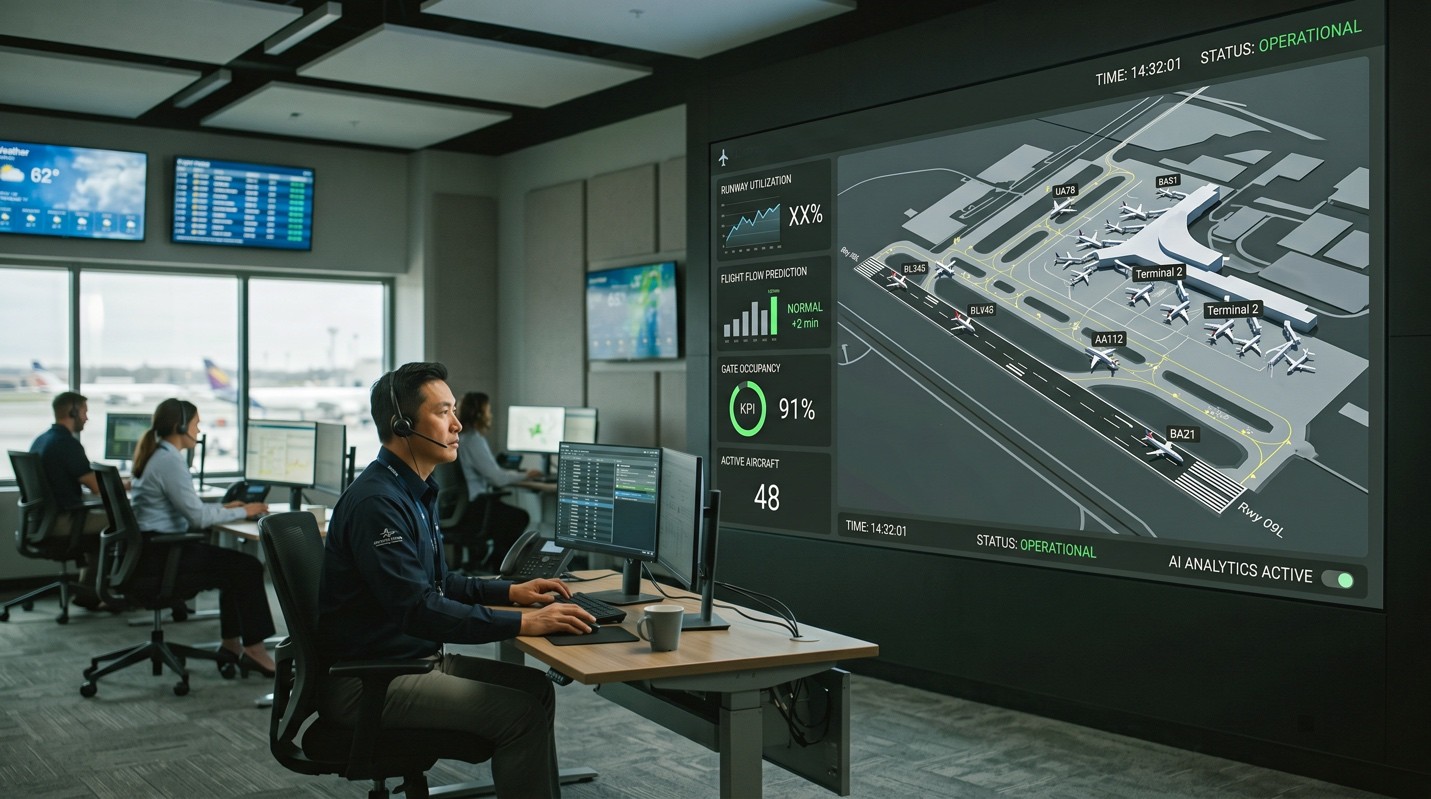
Set the terminology aside and the function is straightforward. A digital twin ingests operational data and reflects it back as a model that teams can test and adjust before anyone commits to a decision in the physical network. A team can reroute a shipment around a closed corridor because the twin can show the effect on every downstream stop before a single truck moves. Similarly, a team can simulate a spike in seasonal volume, and the twin will expose where a warehouse or lane will fail first.
This is where airport analytics translate directly into transport management. The models used by airports to forecast gate congestion or a baggage-belt fault rest on the same underlying logic that can be used to forecast a warehouse bottleneck or a fleet maintenance failure. The domain changes; the mechanics of prediction don’t.
Keeping a connected network secure
All of this depends on trustworthy data flowing between systems. However, most systems were never built to talk to each other. That’s an integration problem before it’s a technology problem. It’s equally a security problem. When sensors, cameras, and scheduling systems all connect to a shared backbone, poor monitoring at any single point puts the whole network at risk.
A cybersecurity solution needs to sit underneath the digital twin from the outset rather than join the architecture at a later date. That means secure data pipelines, access controls that follow the data across every connected system, and continuous monitoring of the infrastructure the twin depends on. Airports established this discipline by running biometric systems, baggage networks, and operational sensors on one shared backbone. Operators in transport and logistics building comparable architectures inherit the same responsibility.
Integration is the foundation
The overlooked failure mode is a digital twin built on six disconnected data sources instead of one reliable layer. System integration and master data management are not the compelling part of this story, but they determine whether the compelling part functions at all. Integrated solutions that unify fleet, warehouse, and scheduling data into a single operational picture give a twin an accurate model of reality instead of a set of guesses.
An operator getting this foundation wrong ends up with a predictive model which reasons from fragmented inputs (no matter how smart the model design). An operator getting it right strengthens visibility across the entire network; a properly integrated environment is easier to monitor than one assembled in pieces over a decade.
Where this leaves transport and logistics leadership
The real question for transport management teams is not whether digital twins work. Airports have already demonstrated that they do. The question is whether the underlying systems carry enough integration to support one honestly. Operations management is shifting from a discipline built on reports of what has already happened to one built on forecasts of what is about to happen. Airport management has spent several years proving the model at scale; networks for transport and logistics are simply the next place it belongs.
WAISL’s systems integration approach helps operators for transport and logistics bring predictive analytics and operational data together into one connected foundation, turning digital twin technology into a working advantage rather than another dashboard no one has time to watch. Get in touch with our team to learn more.